+++ === ++++++ === ++++++ === ++++++ === +++
THE CAUSEWAY, ST. GEORGES, BERMUDA
Original oil - signed: W.E.C. 1899
 In March 1996 an art conservator was commissioned by
Scottish Natural Heritage to undertake an appraisal of “Twenty-Five Easel
Paintings in Kinloch Castle” of which
In March 1996 an art conservator was commissioned by
Scottish Natural Heritage to undertake an appraisal of “Twenty-Five Easel
Paintings in Kinloch Castle” of which
“The Causeway” was one.
The canvas, which measures
12 x 9 inches, and frame were
found to be “stable and sound”.
The surface was described as “poor”
being “engrained
(with) dirt”.
Research has so far failed to reveal the identity of the artist, W.E.C.
St. George's is one of the principal islands of
Bermuda and the first to be extensively colonised. Covering an area of 703
acres it was connected to its neighbouring island, St. David’s, which in turn was connected by a bridge and causeway to the main island, the latter, constructed
by Royal Engineers on reclaimed land, was opened in September 1871
to a plan
approved by Irish born architect Lieutenant-Colonel Sir Albert Hime, R.E.,
and known as Hime’s
Causeway, replacing the Bermuda Government link built
in 1864 and destroyed in
a hurricane.
During the Anglo-Boer War, 1899-1902,
five thousand Boer prisoners were housed
on several of Bermuda’s islands

The canvas is securely fastened to its stretcher /
strainer which is in good condition
with all eight wedges present. The 1996
Appraisal revealed no warping,
splitting, mould or worm damage.
> * <> * <> * <> * <> * <> * <> * <> * <> * <> * <> * <> * <
 Despite the 1871 Causeway being wrecked by a
hurricane on the
1st of September 1880 it was rebuilt to Hime’s original design. Nineteen
years later, on the 14th of September, another hurricane destroyed three
quarters of a mile of the bridge section.
Despite the 1871 Causeway being wrecked by a
hurricane on the
1st of September 1880 it was rebuilt to Hime’s original design. Nineteen
years later, on the 14th of September, another hurricane destroyed three
quarters of a mile of the bridge section.
Hurricanes Felix (1995) and Fabian (2003) again
caused massive damage, resulting in
a tunnel alternative being considered.
Construction of two new bridges, one fixed the other
swing, commenced in 2019 and are due for completion in 2021.
Winsor & Newton, Limited
38 Rathbone Place,
London, W.
(Number) 445791
Founded by William Winsor and Henry Chares Newton in
1832 the firm originally traded as Winsor and Newton and from 1882 as Winsor
and Newton, Limited. It remains today one of very few early 19th
century artist’s supply businesses still trading although no longer in family
hands.
 |
The Army & Navy Co-operative Society, Ltd.
105-107, Victoria Street, Westminster, S.W.
No. 12 Dept. Fine Art Section
Oil Paintings Cleaned, Restored, Relined,
Engravings Cleaned and Repaired
Every description of Gilding, Picture Frames, Girandoles* Furniture, &c., &c.
Order No. 1225 * lighting
|
+++ === ++++++ === ++++++ === ++++++ === +++
ORIGINAL OIL ON CANVAS
An original 21 x 20 inch oil on canvas signed M. Goad.
(Photographed October 2007)
 The edges are scuffed and several areas
have peeled away revealing the ground layer.
The Piper's Room was cleared of its contents c2012 due to damp,
being directly under the cold water tank at the top of the Castle tower.
Some items “disappeared” others were carelessly stored in the
luggage loft off the first floor south corridor.
There is no record of this painting
in any of the four inventories
of contents
in my possession.
+++ === ++++++ === ++++++ === ++++++ === +++
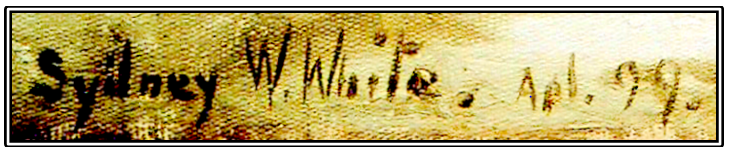
BROCON BEACH BY SYDNEY
WATTS WHITE
A 12 x 8½ inch print on card signed by Sydney W. White and dated Apl. 99 (April 1899).
When the photograph was taken in November 2006
the
picture was stored in the Piper’s Room
off the Gallery
in the Great Hall. It was unframed and unprotected,
the edges
were chipped and the surface
suffering minor scratches.
The reverse bears the inscription: G516 brocon
Beach.
Brocon could refer to the Brocon Pass, located at almost 5,300 feet in the Italian Alps
between the Vanoi and Tesino valleys. The Pass is described as “very wide”
an interesting feature being that for 2½ miles it is level in appearance very much
like the Highlands of Scotland. Its strategic position meant the region played an
important role in both World Wars and reputedly is where underground bunkers
and trenches dug by the Austrian army are still to be found.
+
GLADYS BULLOUGH
(Not Hermione Bullough as originally attributed.)
The painting above left is a 100 x 75 inch oil by Sydney White
of Miss Gladys Bullough, half-sister to George Bullough, and is displayed facing the top of the south stairwell on the first floor south landing in Kinloch Castle.
The work is dated 1901, when Gladys was
thirteen years old, she was born in 1888,
daughter of George Bullough’s father,
John, and his second wife, Alexandria.
The portrait was
for many years considered to be that of Sir George and Lady Bullough’s daughter, Hermione, until
the author noticed the date 1901.
Sir
George and Lady Bullough’s daughter Hermione was not born until the
5th
of November 1906.
I received
confirmation of the identity of Gladys from her cousin,
the Honourable John George Lambton,
son of Hermione, Countess of Durham
and her husband, Lord Lambton, in 2005.
Who commissioned the painting is unknown, Gladys was only three years old when her father, John Bullough, died in 1891
Was it her mother, Alexandra, John Bullough's second wife? 1901 was the tenth
year since her husband died. If that was the case the portrait would have been
originally displayed at Meggernie Castle as the background location depicting the snow
capped Glen Lyon Hills, (the Highland Breadalbane range), would strongly
suggest. It
seems likely, following the sale of Meggernie Castle and Estate in 1919 to
Sir Ernest Salter Wills, Sir George Bullough, Gladys's older half-brother,
acquired the portrait for Kinloch Castle. Such a large family heirloom requires
space and the right setting to be correctly displayed; Kinloch Castle offered
the perfect solution. The portrait today hangs on the landing immediately at
the top of the south staircase.
+++ === ++++++ === ++++++ === ++++++ === +++
MONKS IN WINE CELLAR
A pair of glazed,
ornately gilt framed prints of Monks Sampling Wine described
as being displayed in the “Caretaker’s Dining Room”*
 in the 1978
Inventory of Castle Contents:
in the 1978
Inventory of Castle Contents:
“Item 911 Two coloured prints of monks in wine cellar, in gilt frame, glazed.”
(*See photograph
left taken in July 1998.)
In the 1992 and
1996 Inventories
(pages 46 and 36 respectively), when the Castle
was being run
as an exclusive hotel plus Hostel in
the former servant’s quarters, the prints
are still in the “Caretaker’s Dining Room” which from 1995
(the separate hotel operation having ceased)
was used as a
dining room for non self -catering hostelers and called the “Bistro.”
Both the 1992
and 1996 Inventories record word for word: “Two framed
prints, The Friar Vintners” which are lumped together with “two 18th
century etchings and one other print.”
Photographed in November 2006, the print above,
(along with its pair)
was frameless, unprotected and languishing in the damp
Piper’s Room
with many other damaged pictures.
Why were the
pictures taken down and not replaced?
On whose
authority?
How did their frameless condition happen?
A possible artist is German painter Eduard von
Grüttzner born in Poland in April 1846 and noted for his genre paintings of monks.
He was a
pupil of Bavarian Herman Dyck in Munich thereafter studying at the
Academy of Fine Arts under Karl Theodor von Piloty.
Aged twenty-four Grüttzner opened his own studio in
Munich which proved
so famous that Prince Regent Luitpold of Austria granted him
the title of “professor.”
In 1880 he was awarded the Order of Merit of St.
Michael, and was knighted in 1916.
Eduard von Grüttzner died in Munich in April 1925.
+++ === ++++++ === ++++++ === ++++++ === +++
WATERCOLOUR BY LADY BULLOUGH
Phillips' 1978
Castle Inventory - Item 612:
Location:
Sir George Bullough's Bedroom
Description: “Water
coloured drawing (of) 2 soldiers on horseback in white painted frame.”
The reverse
reads:
“Painted by Monica L. Bullough”
Date
undecipherable.
The painting is
not listed separately in later inventories.
It was found, no
longer in its frame and unprotected, in the Piper's Room in 1997 when the
photographs were taken.
+++ === ++++++ === ++++++ === ++++++ === +++
ENGRAVING SIGNED DOUGLAS ADAMS
This glazed framed engraving measures 26 x 18 inches
the border bears the signature: Douglas Adams (W. Douglas Adams 1853-1920)
The engraving itself is signed: W. Douglas Adams 1893.
W. Douglas Adams
was born in Birmingham (England) in 1853 and died in 1920.
His genre
centred on wildlife, landscape and sporting scenes, particularly Scottish Highland and coastal views. His studio was in London’s Haymarket and he exhibited at a
number of galleries including the Royal Academy.
* ^ ** ^ * * ^ ** ^ ** ^ ** ^ * * ^ ** ^ ** ^ ** ^ * * ^ ** ^ *
The lower edge
of the frame is inscribed:
“J.C.B. TO G.B. August 14th 1896
FORSAN ET HAEC OLIM MEMINISSE JUVABIT.”
(Translates: Perhaps some day it
will please us to recall even these things.)
Quotation from
Virgil’s Aeneid Book 1 line 203.
Clearly a gift
to G.B. (George Bullough) however a search of the Rum Deer Forest
Game Book records no
guest with the initials J.C.B. in the year 1896.
The engraving
depicts the Black Cuillin, a range of gabbro rock mountains on the
Isle of Skye as viewed from Sligachan at the head of Loch Ainort,
one of
the islands many sea lochs.
The peak
is Sgurr nan Gillean (3,170 feet),
to its right Am
Basteir (3,064 feet) with its “tooth” or Inaccessible Peak.
Two stalkers
approach the Royal (twelve
point) Stag they have shot.

The photograph
was taken in May 1996 at which time it was displayed above the fireplace in the
Visitor's Common Room.
The 1978 Phillips of Scotland Inventory of Castle Contents records:
“Item 1230
Hostel Dining Room* Engraving - Landseer of Dead Deer, D. Adams.”
* Former
Caretaker's Dining Room.
In the 1992 and
1996 Inventories it was lumped together as "one other print"
with "two 18th century etchings" and the two gilt framed colour
prints
of monks in their wine cellar.
Around 1996/7
all these pictures were removed when the Dining Room (Bistro)
was redecorated
and never returned.
The Douglas
Adams work was then displayed above the fireplace in the former Ghillies Room
(Visitor’s Common Room by the courtyard gateway).
In 2000 it was removed again, this time being stored on its side directly on the floor in the Gun Room off the Great Hall and consequently no longer on display to visitors.
It was still in
the Gun Room in March 2006 when the image below was taken.
I have found no
evidence that this engraving by Douglas Adams is a copy of an original by Sir Edwin
Landseer as implied in Phillips' 1978 Inventory description.
However, a
colour version exists under the title
“Fallen Monarch”, is that the original and the engraving
a copy by the same artist?
+++++ =+ * += ++++++

ORIGINAL WATERCOLOUR
by BYRON COOPER
George Gordon Byron Cooper was born in Manchester,
England, in 1850.
He commenced his artistic studies at the cities Academy of
Fine Arts and later in Paris under the French naturalist painter Jules Louis
Breton and director of the French Academy Charles Émile Durand.
Aged twenty-nine Cooper first exhibited at London’s
Royal Academy in 1879,
and again in 1883 and 1901.
In 1889 he was awarded Place
of Honour for his painting Grange Fell
exhibited in that years Paris Salon Exhibition.
Cooper painted in both oils and watercolour and
several originals of both depicting views on the island of Rum were
commissioned by Sir George Bullough and hang in Kinloch Castle.
This watercolour measures 51 x 25 inches and depicts
a rocky cleft at the old township of Harris on the island. It is signed lower
right and dated 1902. The ornate gilt frame is deteriorating with large portions already lost particularly along the bottom edge.
This photograph, taken in July 1997, also shows clusters
of black mold spores growing on the inside of the glass due to damp, high humid
conditions.
*** *** + + + *** ****** *** + + + *** ***
REVIEWED 29 NOVEMBER 2022


 In March 1996 an art conservator was commissioned by
Scottish Natural Heritage to undertake an appraisal of “Twenty-Five Easel
Paintings in Kinloch Castle” of which
In March 1996 an art conservator was commissioned by
Scottish Natural Heritage to undertake an appraisal of “Twenty-Five Easel
Paintings in Kinloch Castle” of which

 Despite the 1871 Causeway being wrecked by a
hurricane on the
Despite the 1871 Causeway being wrecked by a
hurricane on the

 The edges are scuffed and several areas


 in the 1978
Inventory of Castle Contents:
in the 1978
Inventory of Castle Contents:


