“GOLDEN MYTH”
Ascot Gold Cup, Ascot Gold Vase and Eclipse Stakes Winner in 1922.
Ascot Gold Cup, Ascot Gold Vase and Eclipse Stakes Winner in 1922.
Written from first-hand research and illustrated by George W. Randall,
co-founder in July 1996 and former Vice Chairman
Kinloch Castle Friends' Association.


*<>*<>*<>*<>*<>*<>*<>*<>*<>*<>*<>*<>*<>*<>*<>*<>*<>*<>*<>*<>
His sire and dam were 15th Generation Tail Male descendants of Foundation Stallion, Darley Arabian (b. 1700) via undefeated Eclipse b. 1 April 1764, (named after the Solar Eclipse that occurred the same month), bred by Prince William Augustus, Duke of Cumberland, third and youngest son of King George II.

* >< * >< * >< *><* >< * >< * >< *><* >< * >< * >< *>< *
AUTHOR BACKGROUND INTRODUCTION:


Sir George Bullough's recorded racing career spanned thirty years during which he owned over one hundred and fifty thoroughbreds - all traced and named.
A long time member of the National Hunt Committee and Jockey Club, (holding several official positions), he was also a member of the Racecourse Betting Control Board and the Council of the Thoroughbred Breeders' Association, where, as owner of Longholes Stud Farm, Newmarket, he took a particular interest in investigations into sterility.
From 1903 he was Master of the Ledbury Hounds, resigning in 1921 in favour of his half-brother John, popularly known as Ian. The same year he sold all his jumping horses and moved into flat racing, his thoroughbreds being trained at Park Lodge, Newmarket, by up and coming former jockey now trainer, Jack Layton Jarvis.
Sir George's colours were cerise with purple sleeve shirt and purple hat.
*

Male Line Sires:
.
Tredennis (b.1898 d. 1926) A leading sire in Great Britain and later Argentina.
His progeny won over 480 races.

Kendal (b 1883) 8 starts eight wins as 2 year old. including Newmarket July Stakes over six furlongs. Due to injury received during training in late 1885 he was retired and sold to stud in Ireland. From 1893 to 1901 he stood at stud in England before being sent to Haras Ojo de Agua Stud, Buenos Aires, Argentina.
Bend Or (b 1877) Owned by the 1st Duke of Westminster. 14 starts 10 wins,
including 1880 Epsom Derby and Champion Stakes.
Doncaster (b 1870) Winner Epsom Derby and Ascot Gold Cup. From 1884
stood at Kisber Imperial-Royal Stud, Hungary.
Female Line Sires:
Persimmon (b 1893) owned by HRH Edward, Prince of Wales
9 starts 7 wins, including Epsom Derby, Doncaster St. Leger, Ascot Gold Cup
and Sandown Eclipse Stakes. He was the sire of Golden Lily born 1907.
St. Simon (b 1881) owned by Duke of Portland, 9 starts 9 wins including Ascot Gold Cup, Champion Sire nine time and Champion Brood Mare Sire six times.
Galopin (b 1872) 11 starts ten wins including Epsom and Newmarket Derby,
leading sire in Great Britain and Ireland 1888, 1889 and 1898. He was top broodmare sire four times, his progeny included U.K. Triple Crown Champion, Flying Fox.
*
 |
| Sir George Bullough, Baronet, purchased Golden Myth as a yearling for 1,400 guineas in 1919. |
Bred in Ireland and foaled in 1918, Golden Myth was a bay colt by Tredennis out of Golden Lily by Edward Prince of Wales' Persimmon, purchased as a yearling on Sir George's behalf by his newly appointed trainer, Jack Jarvis*, for 1,400 guineas*.
* 1,400 guineas = ₤2,070, equivalent to about ₤90,000 in 2024. UK Inflation Calculator.
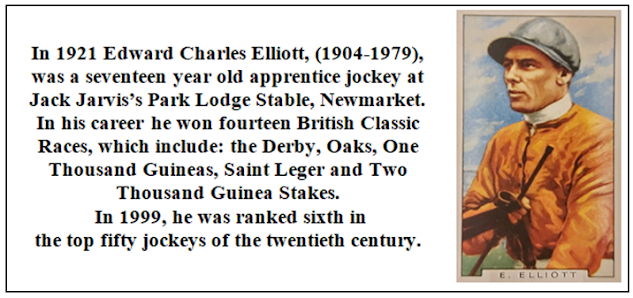
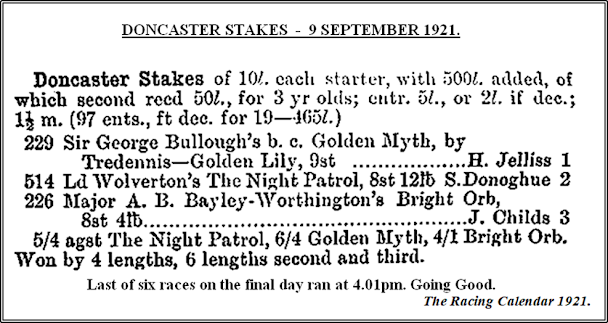
He first raced as a three year old winning his first two races, the Bentinck Maiden Plate over 1½ miles by half-a-length ridden by Charlie Elliott at Nottingham; and the Newmarket Shelford Plate over 1¾ miles by a short head ridden by Nathan Spear. In June Golden Myth came a close third to Copyright and Tishy (short head and a neck) in the 1921 Ascot Gold Vase over 2 miles ridden by Henri Jelliss at 9/4. The same month at Ascot, ridden again by Jelliss, he came third by three lengths in the Hardwicke Stakes over 1½ miles to Lord Carnarvon's Franklin and J. de Rothschild's Milenko. On the ninth of September at Doncaster in the Doncaster Stakes, with Henri Jelliss up, Golden Myth won by four lengths at 6/4 in a field of three.
On 30 September in the Newmarket St. Leger over the last 1¾ miles of the Cesarewitch Course, ridden again by Henri Jelliss at 13/8 on, Golden Myth finished third by 2½ lengths to Sol Joel's Napolyon (one length) and His Majesty's Perfect Knight (1½ lengths).
These performances showed that whatever else he might or might not be, Sir George's stallion was a stayer.
Thus the stage was set for the 1922 Flat Racing Season.


Golden Myth was immediately retired to stud at a fee of 200 guineas*.
(* 200 guineas = £210, equivalent to over £13,000
in 2022. Ref: Office for National Statistics CPI.
Sir George's 1922 winnings placed him fourth in the Annual League of Winning Owners, with seven of his horses winning thirteen races.
* In his autobiography, "They're Off", Jack Jarvis writes the success of Golden Myth
established his reputation as a trainer of thoroughbreds.
Knighted by Her Majesty the Queen in 1967 for his services to horse racing,
established his reputation as a trainer of thoroughbreds.
Knighted by Her Majesty the Queen in 1967 for his services to horse racing,
Sir Jack passed away the following year at the age of eighty.

* >< * >< * >< *><* >< * >< * >< *><* >< * >< * >< *>< *


Above: Advert for Stallions Standing in 1923 from Bloodstock Breeders' Review.
Both Golden Myth's direct male and female pedigree
trace back to foundation stallion the Darley Arabian.
---------------------------------------
As a sire of future winners Golden Myth was something of a disappointment.
In his autobiography, "They're Off", Sir Jack Jarvis writes:
"(Golden Myth) proved to be one of the most deplorable failures at stud
I have ever known and hardly sired a winner of any description, the painful fact
(was) that most of them just could not go ..."
His stud fees, initially 200 guineas, although reduced to 99 sovereigns in 1929,
added up nicely, totaling over £1,000,000 in present day terms.
A further four winners were added in 1927 and seven in 1928.
Golden Myth's most notable winner was Mr. H. S. Gray's Sea Serpent out of Seabloom by Spearmint, (winner of the 1906 English Derby Stakes), born 1928.
He ran twice in 1931 winning the Baldoyle Derby and Irish Derby
at the Curragh June Meeting, a total of £4,507.
Sea Serpent ran three times the following year, finishing second in the Burwell Stakes at Newmarket before being retired to Grog Magog Hills near Cambridge, England from 1933 to 1936. He later stood at Loughbrown Stud, the Curragh, County Kildare, Ireland, and Ross House Stud, County Cavan, Ireland.
Following his 1922 Season Golden Myth went to The Earl of Rosebery's Mentmore Stud.

Weatherby & Sons' Racing Calendar 1922 * George W. Randall Research and Photographic Archive

* * * * * * * * < * >* * * * * * * *
Golden Myth did not run as a 2 Year-old.
*
In 1921 as a 3 Year-old Golden Myth ran six races
winning three and being place third in three:




ASCOT GOLD VASE


HARDWICKE STAKES


DONCASTER STAKES


NEWMARKET ST. LEGER


* * * * * * * * * * * * * * * * * * * * *


KING COLE STAKES


< * >< * >< ** >< * >< * >< * ASCOT HEATH, BERKSHIRE * >< * >< * >< ** >< * >< * >

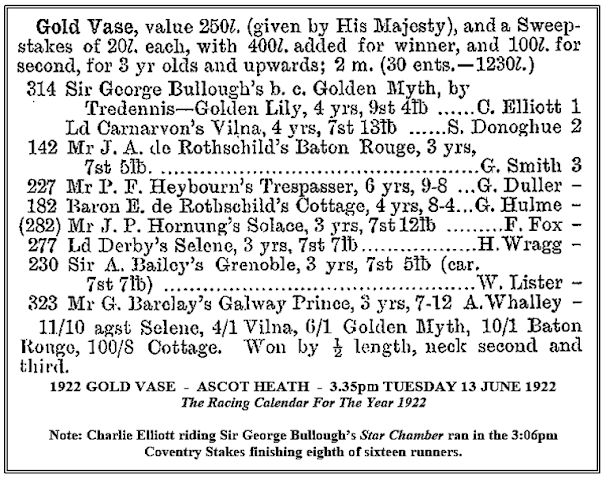
The original ASCOT GOLD VASE was donated by Queen Victoria in 1838 following her accession on 20 June the previous year.
Originally for three year-olds it allowed older horses in 1840.
Renamed the King's Vase in 1903 it was named the Queen's Vase in 1960.
Inaugurated in 1807, the historic ASCOT GOLD CUP is amongst the most-coveted trophies in flat racing. Along with the Royal Hunt Cup, the Gold Vase and Gold Cup they are perpetual trophies, being kept permanently by the winning owners.



The Gold Cup is Ascot's oldest surviving race.

.


.
Description of the Sandown Park Course in 1922.


Eclipse Stakes


<*><*><*><*><*><*><*><*><*><*><*><*><*><*><*>

George W. Randall Research and Photographic Archive ©
REVIEWED 27 JANUARY 2026.
*********************************************************************************


