KINLOCH CASTLE, WALLED GARDEN, HOTHOUSES & GARDENERS.
Researched and written by George W. Randall.

Mr. Peter Wormell, the walled garden was used to raise seedlings for
the Great Woodland Regeneration Scheme .
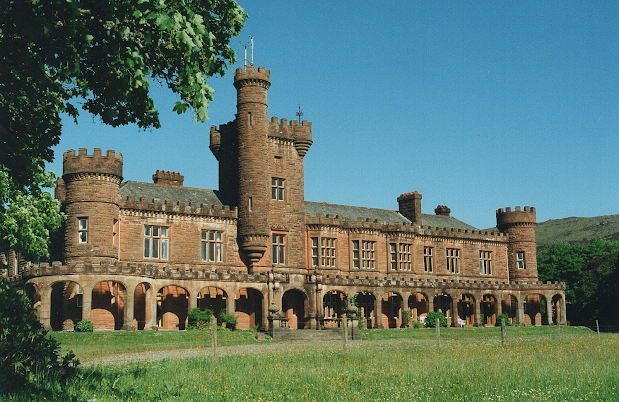
George Bullough as his Highland Hunting Lodge.
SEE ALSO:

Includes detailed drawings of Hot Houses from original plans ... ... ...
.


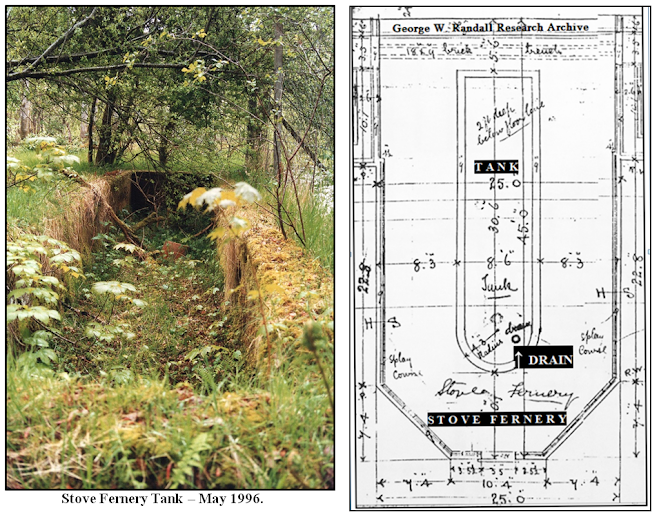
Measuring 29 feet long by 7 feet in width, (internal dimensions), the sunken element of the Stove Fernery tank had a depth of two feet, i.e. to floor level, it was surmounted by a two foot high, nine inch thick brick wall.
The earth would act as a natural insulator regulating temperatures, the Stove Fernery greenhouse providing high humidity and warmth, ideal for tropical species, while allowing them to experience natural sunlight.
.
The tank held 406 cubic feet of water weighing approximately eleven tons -
24,500 imperial gallons.
A drain hole in the semi-circular end allowed for maintenance of water quality.
The Plans do not indicate a slope to the drain in the brick bottom,
or mention of water filtration.
The tank was home to terrapins and as such would have had to have rocks or a platform for the turtles to climb out of the water - known as basking areas.
.
There is no evidence alligators were kept, (they would soon grow to unmanageable size), I was told by former islander Jim Smith there was a heated snake pit between the castle and walled garden, and a mounted snake is displayed in the castle.
(Source: Jimmy Smith, island resident 1938 - 1967.)
.


>+< >+< >+< + >+< >+< >+<
TO SEE MY FULL RESEACH INTO THE HOT-HOUSES ENTER:

BACKGROUND INTRODUCTION:


> < + > < * > < + > <
THE HOT-HOUSE COMPLEX
already no more ... ... ...


>+< >+< >+<
BUILDER'S PLANS REPRODUCED:


George Bullough, 1870 - 1939, (from 1901 Sir
George), commissioned construction of Kinloch Castle which commenced in
mid-1897 and lasted three years. He furnished his island home with an amazing assortment
of contents, many collected on his world travels, and one with links to the
Emperor of Japan. The walls display over three hundred pictures – oil,
watercolour and fine engravings, all I have personally photographically
recorded, measured and researched.
Also recorded are the twenty
albums containing over seven hundred photographs of twenty-two year old
Bullough’s three yearlong world tour 1892-1895. His library shelves hold over 1,500 volumes, including three Game Books – which, commencing 1866, provide a
social record covering seventy years of the island’s sporting guests, the
successful ones only of course
__ + __
 |
| Sir George Bullough's Ballymacad, winner of the 1917 Grand National held at Gatwick, the course today being part of the international airport. |
 |
| Sir George Bullough, Bt. |
Between 1910 and his death in
1939 Sir George Bullough owned over one hundred and fifty racehorses. As a
long time member of the Jockey Club, my research, which remains
on-going, has taken me several times to Newmarket, the very heart of flat
racing and the training stables he used and the breeding facility he owned. I
was privileged to be given access to the Jockey Club and their extensive
library.
Owner of two magnificent ocean-going
steam yachts, 1895 – 1919, Sir George sailed the world, he was member of the Royal
Clyde Yacht Club and the Royal Bombay Yacht Club. In late 1899 he equipped and
staffed “Rhouma I” as a hospital ship and personally sailed with her to Table
Bay, Cape Town, where the vessel was placed at the disposal of Queen Victoria’s
forces in the Anglo Boer War which commenced on 11 October that year.
The many facets of the Kinloch Castle story have become my passion, and
here I must acknowledge the support of S.N.H. personnel both on and off the
island in order to conduct my research.


My early work was recognised in 1996 when I was approached by the late broadcaster
and journalist Magnus Magnusson, K.B.E., at the time chairman of Scottish
Natural Heritage, (S.N.H.), who was compiling a fortieth anniversary book
entitled, “Rum: Nature’s Island”, with a request to make available my
research to his chapters on the Bullough Family and Kinloch Castle. I readily
agreed and met Mr. Magnusson at his home in Scotland.


In 2000 my illustrated account of
Bullough and his castle was published in a local history of Accrington, the
Lancashire town where James Bullough, (George Bullough’s grandfather), in
partnership with John Howard, founded a factory manufacturing a full range of
machinery for the cotton spinning industry - Howard & Bullough, Ltd., founded
in 1853. In 1893 a second facility, the
Howard & Bullough American Machine Company, was opened at Pawtucket, Rhode
Island, U.S.A.
In 2003 a BBC producer contacted me to discuss
input for the forthcoming Restoration
programme highlighting the plight of Kinloch Castle. In 2011, after a request
from the London based Public Catalogue Foundation and S.N.H., I wrote the
background notes to each of the thirty-two oil painting from the Castle
featured on the BBC My Paintings –
Kinloch Castle website.
In 2012 I received a request on
behalf of S.N.H. to supply photographs and check over the text for their new
Kinloch Castle Brochure. It was, as usual, difficult to contain my enthusiasm within
the parameters set as there is so much of interest to bring to a visitor’s
attention … … however I did my best.
I have also written and
illustrated a number of papers on specific areas within my research which were
circulated privately.
This brings me back to the
purpose of my Blog … … to share my research and concerns for the future
availability of this incredible publicly owned building together with its original
contents in the hope both can be saved for future generations as part of
Britain’s cultural heritage. Together they form a surviving example of
Edwardian splendour which in so many cases quickly disappeared after the
1914-1918 war.
To quote Sir John Betjeman, (British
Poet Laureate 1972 – 1984), who wrote almost fifty years ago:

“In time to come
Kinloch Castle will be a place of pilgrimage for all those who want to see how
people lived in good King Edward’s days.”
Sir John Betjeman - Poet Laureate from 1972-1984.
> * <> * <> * <> * <> * <> * <


A single Eucalyptus tree stands just north of Kinloch Castle.
Turn the camera 180 degrees and you see ... ...


It is up to us to recognise and ensure the architectural
and social heritage enshrined within Kinloch Castle
continues for generations to come as
“a place of pilgrimage for all those who want to see
how people lived in good King Edward’s days.”

The Rose of Scotland
from a stained-glass window in the Great Hall at Kinloch Castle.

Reviewed with added material 8 December 2025 by George W. Randall.

Good job, George. I look forward to reading more.
ReplyDelete