KINLOCH CASTLE
HOT-HOUSES AND TREE-NURSERY
Researched, written and illustrated by George W. Randall.

(Dated c.1951 by Jimmy Smith, island resident 1938 - 1967.)
Many framed sections from the disintegrating glasshouse
were recovered by residents to build small greenhouses in their gardens.


.
<+> <+> <+> * <+> <+> <+>
.
BACKGROUND INTRODUCTION TO THE AUTHOR:
.


.
(The Newsletter was deemed by a certain self-appointed KCFA member to
"have little value" at which point publication ceased.)

The height at the rear wall was 13 feet 8 inches.
The height to the Apex was 15 feet 8 inches.
The floor inside (wall to wall) was 18 feet 3 inches.


The Victorian Age ushered in the Golden Era of greenhouses.
Glass was manufactured in vast quantities as the wealthy competed to build ever more elaborate structures for exotic fruit and flowers.
.
Victorian walled gardens had extensive, multi-sectioned greenhouses facing south
against their north wall for controlling the growing stages of plants.

Another example of a greenhouse of the period similar to the survivor at
Meggernie Castle, Highland home of John Bullough, Sir George Bullough's father.
.
NOTE: The Glasshouses at Kinloch Castle both in size and extent were in no way similar to the greenhouse at Meggernie Castle as has been claimed.
.
 \
\.


*
WORKING DRAWING OF THE KINLOCH CASTLE GLASSHOUSES
by R. Halliday & Co., Middleton, Manchester.


Builder’s Plan Scale:
⅛ inch equals 1 foot or 1 : 96
.
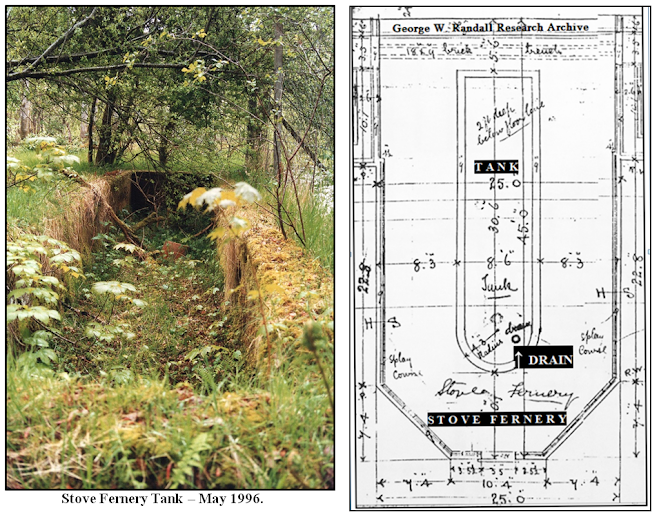
SOUTH FACING PAVILION AND STOVE FERNERY
.

THE STOVE FERNERY, was a glasshouse kept at high temperature for growing tropical plants. The Kinloch Castle stove fernery included a Tank 8 ft. 6 inches wide by
30 ft. 6 inches in overall length including 9 inch block retaining wall all round.
It held approximately 460 cubic feet or 24,600 gallons of water which weighed eleven tons.
.
Turtles, (more likely terrapins), were kept in the central Stove Fernery Tank which had an internal length of 29 feet 6 inches and width of 7 feet. The tank itself had a depth (below floor level) of two feet, i.e. floor of tank to top of surrounding wall four feet.
The 9 inches thick retaining wall was two foot high all round.

There is no evidence alligators were kept, but I was told by former islander Jim Smith there was a heated snake pit between the castle and walled garden,
and a mounted snake is displayed in the castle.
(Source: Jimmy Smith, island resident 1938 - 1967.)
.
* >< * >< * >< *>< * > + < * >< *>< * >< * >< *
.
STOVE FERNERY AND TANK (DETAIL)



.

THE CAMELIA HOUSE

Where Humming Birds flew freely.

<+> <+> <+> <+> <+> <+> <+> <+> <+> <+> <+> <+>
Layout at time of Sir George Bullough's death in 1939.
(Source: Jimmy Smith, island resident 1938 - 1967.)

<+> <+> <+> <+> <+> <+> <+> <+> <+> <+> <+> <+>


<+> <+> <+> <+> <+> <+><+> <+> <+> <+> <+> <+>


Removed and stolen shortly thereafter!
.


Heating for the glasshouses was provided from a dedicated boiler house against the
north facing back wall through a double row horseshoe pipes running along the front
of the multi-sectioned greenhouses, with sunken pipes underneath a grilled walkway
full length at the back and all around the Palm Houses.


eliminating hot spots the cause of poor growth.
Light levels make the plants grow faster and flowers bloom sooner.


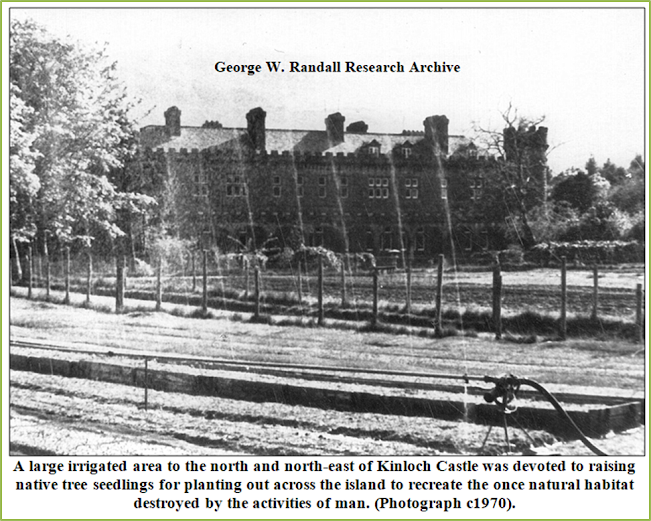
TREE NURSERY




> * < > * < > THE GLASSHOUSES < > * < > * <


THE GREENHOUSE COMPLEX AT KINLOCH
CASTLE
Researched, written and illustrated
by George W. Randall © June 2008
1 : 600 scale sketches taken from original Builder's Plans.
.

Originally published in Kinloch Castle Friends’ Association Newsletter
Number 26, July 2008.


>>> >>> + <<< <<<


(Photograph Jimmy Smith courtesy Ina Smith.)


.
<> * <><> * <><> * <><> * <><> * <><> * <><> * <><> * <><> * <>
.
THE ARTICLE BELOW WAS FIRST PUBLISHED IN MAY 2005
IN THE KINLOCH CASTLE FRIENDS' ASSOCIATION NEWSLETTER
BY GEORGE W. RANDALL,
IT IS THE RESULT OF FIRST HAND ON-SITE RESEARCH BY THE AUTHOR


"Research, connecting the dots of history."

A REAL THREAT ... ... ...


REVIEWED BY AUTHOR 2 OCTOBER 2026
George W. Randall Research Archive Copyright ©

No comments:
Post a Comment